
Autoimmunity Stratification: The Greatest Blind Spot in T1D Cure Research
The path towards curing T1D is advancing quickly, but a critical piece is missing.


When I was diagnosed with T1D in 1973, this was the whole protocol: take one long acting basal insulin in the morning, and go live your life. Maybe a bolus of Regular for a meal or two. No meter. No A1c. No number to hit or miss, and nothing much for the doctor to do other than write prescriptions and then treat you when your organs started failing.
But I was assured that a cure was only five years away. “By 1980 at the latest!”, my endo assured me.
The absurdity from today’s view is sobering, and it has nothing to do with a cure. It has to do with basic daily T1D management. There was no way to test blood glucose levels. It’s not because the technology didn’t exist. It did. It’s that it wasn’t commercialized and deployed.
Instead, it sat in hospital labs from 1970 until around 1980, when the first meters for home use finally reached patients. Even then, it wasn’t taken up for another ten years due to poor demand and lack of patient education. It took that long because the ADA didn’t push it, and the JDRF never had it on the radar. The most important number in the disease was measurable for years, and no one with the power to move it acted.
The same story with glycated hemoglobin — the HbA1c that we know and love today. The NIH paper, HbA1c Standardisation: History, Science and Politics, explains how the A1c test was developed around 1977, but it sat for more than a decade until the procedure was standardized in the mid-1980s. And yet even then, only 50% of labs were using it in 1993. It wasn’t until 2004 before 99% of laboratories were actually reporting it.
What does all this have to do with our drive towards a cure?
Everything. If you’re going to cure T1D, you need to either suppress or get around the immune system. And if you can’t monitor the immune system’s activity, you’re making the same wild, uninformed guesses that we T1Ds were doing in the 1970s with insulin dosing. You need a meter. And just as glucose testing technology was available, but unused for decades, the technology to monitor autoimmune activity exists today, and it’s not being used by the same companies that are developing cures.
I’ve stated this before in prior articles, but I didn’t emphasize it strongly enough. This article aims to clarify this assertion.
Autoimmunity is not on/off — It Throttles
In each of my prior articles on the path towards a cure for T1D, I present a different angle. One is about immune suppression, another is about stem-cell derived islets, and others talk about the various components and hurdles that need to be overcome.
The throughline among all of them is that the central barrier to a durable cure is the immune system, and yet, we’re treating everyone exactly the same: that we all have the same level of hyperactive autoimmunity.
Yes, it’s true that for many of us, our immune system killed the beta cells in our pancreas. We constantly have to explain that to people who conflate it with type 2 diabetes. No, we’re not them. Moreover, once beta cells are gone and exogenous insulin is required, it no longer matters how you got the disease.
But, as all my articles have stated, the immune system is not a binary on/off state. It throttles. And if you’re going to develop a cure, you must take this into account. Indeed, many T1Ds are entirely non-autoimmune. I provide the greatest number of citations on this in my article, To Cure T1D, Start with the Easiest Cases, Not the Hardest, where I quote the surprising statistic that nearly 22% of people diagnosed with T1D show no detectable autoimmune activity — their diabetes arises through non-autoimmune mechanisms entirely.
These statistics come from a number of sources, including a 2022 global scoping review by Ross and colleagues at the Harvard T.H. Chan School of Public Health, which pooled 125 studies across 48 countries. In the aggregate, they found that islet-autoantibody positivity varies enormously by region.
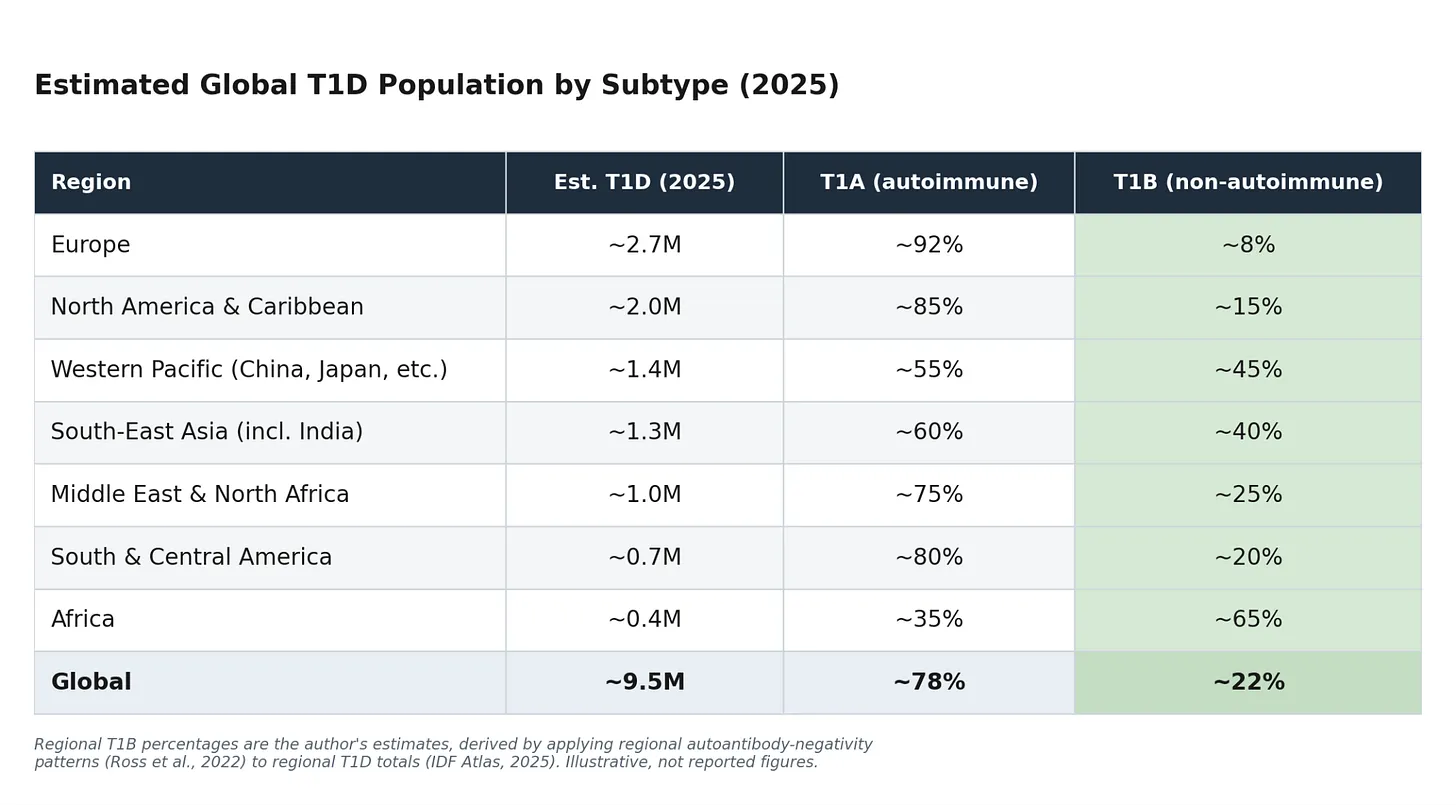
Keep in mind, these are autoantibody negative assays. Beta cells are killed by T cells. Autoantibodies are the byproduct of a destruction that has already taken place (or is in the process). They’re like the bullet casings at the scene of a crime. You know it happened, but you have no idea whether the killer is still there, or will come back. In other words, these antibody assays are imperfect. People who test negative may well have autoimmunity, but the immunity has waned such that there are no more antibodies left to detect. But that itself is worth noting: if autoimmunity wanes, then aren’t these people “functionally autoimmune” for transplant purposes?
These are great questions that open even more questions: if autoimmunity wanes, does it come back? Would these people be candidates for different kinds of curative therapies than those with higher levels of autoimmunity? Think of LADA patients — those who develop T1D gradually in adulthood. Estimates put LADA at 2–12% of all adult-onset diabetes, but what matters here is tempo: LADA progresses slowly enough that patients go years before presenting, and are routinely misdiagnosed as T2D along the way.
Testing for autoimmune T cell activity — not autoantibodies — is far more informative, because it reveals not just who is non-autoimmune, but how intense the autoimmune activity is. Just as T1D management is hit-and-miss without the ability to test for glucose in the bloodstream, a cure will be similarly erratic until we test for the presence and magnitude of a person’s autoimmunity. And unlike a bolusing error, a therapeutic drug that may restrict your immune system’s response to cancer and other opportunistic infections is a lot worse than just a hypo.
This was the mechanism underneath my “start with the easiest cases” argument. That piece made a sequencing case — build from the base of the pyramid upward — and stratification is what makes the sequence possible. You cannot start with the easiest cases if you have no way to identify them.
Despite the field knowing that autoimmunity throttles, the tools to measure it in real time are not being deployed. They’re sitting in a research lab in Australia, where the researcher is struggling to get funding. Not only are organizations hardly paying attention to this, they’re withdrawing funds from this research.
And the worst part is that building this assay that detects autoimmunity thresholds is the fastest, least-expensive, lowest-barrier technology in the entire field of T1D science. There is no area of research in T1D that does not benefit from this assay. The cost and resources to develop it to the point of widespread commercial deployment are infinitesimal compared to the time, cost and lives we’re investing today.
And to pour salt on the wound — or pour glucose into a DKA patient — all those other technologies need to assess autoimmune T cell activity if those are even going to work.
So, what is this assay?
BASTA — A First Generation Deployable Assay
BASTA — the Beta cell Antigen Specific T cell Assay — comes out of Stuart Mannering’s lab at St. Vincent’s Institute of Medical Research in Melbourne. He published his findings in Science Translational Medicine in 2025, and what makes it matter isn’t sophistication; it’s the simplicity.
To explain how it works, we start with what we ultimately need from it, which is embarrassingly simple. Draw a small tube of blood from the patient—about the same amount you’d take for any traditional lab work—and add the proteins that beta cells make. These are the same proteins the immune system attacks in type 1 diabetes. If the person’s autoimmunity is active, the T cells in that test tube of blood will recognize those proteins and react. If they don’t react, nothing happens and we know the person is non-autoimmune. But if there is a reaction, we want to know more than whether a reaction occurred, we want to know how strong it is, how much of the attack is underway.
This is not technically hard, per se, but the historical methods to do it have been intensive and equipment-heavy. Prior to BASTA, a very large blood draw was required because the abundance of these cells we’re looking for is very rare. The lower the abundance, the higher the resolution you need to detect them—hence, a larger volume of blood. In current protocols, research-grade equipment is needed that only a few labs have. In short, a huge amount of blood, a very long turnaround time to results, and extremely expensive equipment and radioactive processes.
In the BASTA assay, if a person has autoimmunity, their T cell receptors engage the antigens in the tube, and that readout is a protein called IL-2. It acts as a proliferation signal, telling the T cell and its neighbors to multiply into a larger population. It therefore acts both as the announcement that a T cell has recognized its target, and the fuel that expands the response.
BASTA listens for that signal, which happens within hours of the T cell recognizing its target. Catching that early signal is what makes the test both fast and sensitive — it reads a reaction in a day instead of a week, and it picks up autoreactive T cells too scarce for the older methods to detect. And because the amount of IL-2 climbs with the strength of the response, BASTA answers the “how much” directly: a bigger signal means a larger share of the immune system is engaged in the attack.
The practical advantages compound:
24-hour turnaround versus five to seven days. Clinically actionable in a way the prior assays never were.
Plasma can be frozen after the culture step and shipped to a central lab for batch MSD analysis. This is the logistical breakthrough. It breaks the fresh-blood-only constraint that has confined every prior assay to specialized centers. A trial site anywhere in the world can collect blood, set up the 24-hour culture, freeze the plasma, and ship it. The measurement infrastructure lives at one central location.
0.5 mL of blood per antigen treatment. Compatible with pediatric populations, with frequent serial sampling, and with blood draws that are already occurring as part of trial protocols.
Quantitative magnitude, not binary. Returns a continuous IL-2 signal reflecting real-time intensity of antigen-specific T cell activity, tracking exactly how autoimmune a patient is over time, against which antigens, and whether that activity is increasing or decreasing in response to treatment.
No radioactivity. Standard biosafety requirements only.
The published performance backs this up. Asked to separate people with new-onset T1D from people without it, the test was accurate about 86% of the time using a single beta-cell antigen, and about 93% using a small panel of insulin-derived peptides in adults — strong for a test this simple. It also distinguished stages of risk that antibody tests blur together: among at-risk children carrying multiple diabetes-related antibodies, the T-cell response was markedly higher than in children carrying only one, meaning BASTA can see who is further down the road, not just who is on it.
And when people with established T1D were tested four times over several weeks, their results held steady — the signal is stable enough to track a patient over time rather than giving a different answer at every visit.
The assay isn’t perfect yet. It still faces engineering challenges: the test-to-test variability needs to be tightened for individual tracking, children occasionally show baseline immune background noise that blurs early detection, and the full panel of target proteins is still being validated. These are standard development hurdles, not dealbreakers—the kind of issues that get ironed out once an assay is run at volume.
These are solvable problems. They are the development agenda, not dealbreakers. And they are the kind of problem that gets solved by use — assays tighten when they are run at volume, on real cohorts, against real endpoints.
Therapies that require autoimmune T cell testing
Now we can talk about curing T1D.
The problem with how clinical trials are run today is that they are looking for different endpoints: A1c levels, time in range, C-peptide, and other biomarkers. When you put new islets into a person, investigators track each of these endpoints because they show whether the islets are producing their own insulin.
The problem is, whatever the intervention is, those very same endpoints could be affected by the person’s autoimmunity. If they’re totally non-autoimmune, the new islets might be working independently of the drug.
Transplanted islets face two different attacks: Alloimmunity is rejection of foreign tissue — the recipient recognizing donor cells as not-self. Autoimmunity is the original disease, aimed at beta-cell proteins regardless of whose cells they are. And both are very different in their response mechanisms.
Nearly everything the field has built addresses the alloimmunity with the expectation that it’ll capture autoimmunity at the same time. That is, suppress T cell activity.
But it’s not that simple. Alloimmune rejection does not produce a beta-cell-antigen-specific T cell response. Recurrent autoimmunity does. So when a graft is lost, a rising BASTA signal points at the disease coming back, and a flat one points somewhere else — rejection, drug toxicity, or an islet that never engrafted properly. Today all three arrive at the same place: a graft that stopped working, and no way to say which thing killed it.
For example, consider the cell-replacement therapies at center stage. In December 2024, a single patient at Uppsala University Hospital received Sana Biotechnology’s hypoimmune-engineered islets transplanted into the forearm without immunosuppression. The term is worth pinning down, because it's routinely misread: hypoimmune describes the gene editing, not the cell source. UP421 used primary islets recovered from a deceased donor, then edited. Sana's stem-cell-derived version of the same platform — SC451, built from iPSCs carrying identical edits — has not yet entered the clinic, though Sana expects to begin a Phase 1 trial in 2026. (As of Sana's Q1 2026 report (May 11), Sana is conducting nonclinical testing, manufacturing transfer to contract manufacturers, and clinical trial preparation, and expects to file an IND and begin a Phase 1 trial for SC451 this year. The July 13 NEJM follow-on release repeats the same expectation.)
The results from UP421, published in the New England Journal of Medicine and celebrated widely, showed that, at 14 months, the beta cells were still producing insulin with no detectable immune response.
But wait, there are multiple problems here. First, hypoimmune editing strips the markers that flag a cell as foreign — which is an alloimmune solution. Recurrent autoimmunity recognizes the beta cell by what it makes, not by whose it is, and no amount of editing changes that.
So, we have absolutely no idea why this single patient’s islets kept working because their autoimmune profile was never characterized. Whether the hypoimmune engineering worked, or whether the patient’s own attenuated (or even entirely absent) autoimmunity contributed to the outcome, is unknown.
Moreover, the islet mass was intentionally very low, because the goal was to see if there was an immune response (not whether it yielded glycemic control). With low islet mass and no measurement of autoimmune activity, there is nothing about this trial that can be generalizable. And even if this patient carried high autoimmune activity, the deliberately sub-therapeutic islet mass may not have provided sufficient antigenic stimulus to trigger a measurable response — leaving open the question of whether a full therapeutic dose would fare the same.
There’s more unknown information about this trial than known, and that’s where science can be susceptible to misdirection for years to come. This is a harbinger for all trials.
Next, consider Vertex’s Zimislecel trial — now in Phase 3, enrolling approximately 50 patients, where the same immunosuppressive regimen is applied to every participant. Will grafts fail regardless of the drug, because their pre-existing T cell autoreactivity will overwhelm the graft before immunosuppression can establish control? Might others succeed with less intervention because they simply don’t need it (because their immune response is attenuated)?
Now add Eledon’s tegoprubart trial, where 12 patients are showing promising outcomes. The same question arise, but in reverse: are those results evidence that tegoprubart works, or evidence that some subset of those patients had low baseline autoimmunity? Without pre-transplant immune profiling, the two explanations are indistinguishable — and the dosing implications of each are entirely different.
A further question cuts across all three trials: will the introduction of new islets trigger a resurgence of T cell activity in patients whose autoimmunity might appear to have waned? If so, by how much? We simply don’t know.
As it happens, there are two trials that took place in 2008 and 2009 — nearly twenty years ago — that demonstrated exactly this.
Huurman et al., PLOS ONE, 2008, enrolled 21 long-duration T1D patients receiving cultured cadaveric islet cell grafts using the traditional protocol. Before transplantation, and at regular intervals for one year afterward, the investigators measured cellular autoreactivity against islet antigens using LST — a Lymphocyte Stimulation Test — which is one of those older assays described earlier that BASTA replaces.
The findings were stark. Seven of eight patients without pre-existing T cell autoreactivity became insulin independent. None of the four patients reactive to both GAD and IA-2 before transplantation achieved insulin independence.
Crucially, autoantibody levels showed no such association — confirming that what mattered was not past immune activity, but the T cell activity itself, measured in real time.
Hilbrands et al., Diabetes, 2009, extended these findings in a cohort of 30 consecutively transplanted recipients under the same protocol. The results reinforced and expanded what Huurman had shown: of nine patients without baseline T cell autoreactivity, seven became insulin independent. Of 18 who tested positive, only six did. Combining T cell autoreactivity with B cell count above the median, the discrimination became even sharper: seven of eight patients with low immune burden became insulin independent; only one of eleven with high immune burden did.
The field has been generating this kind of noise for twenty years. The Bedrat et al. paper published in Diabetologia in July 2026 analyzed 560 TrialNet participants across six immunotherapy trials and made a striking finding that few have noticed. Two immunologically distinct subgroups with different therapeutic responses had been enrolled together in every trial, treated identically, and only identified retrospectively through transcriptomic analysis: subgroup one showed better responses to anti-CD20 therapy; subgroup two showed better responses to CTLA4-Ig.
The same patients, the same trials, opposite therapeutic implications — depending on which subgroup they belonged to. Nobody knew which subgroup any individual patient was in, because nobody measured it prospectively. The variable participant responses that have confounded trial after trial were not random. They were structured heterogeneity that no one thought to characterize before enrollment.
This is the cost of not stratifying.
Together these papers established three things that remain true today:
First, the immune profile of the recipient at the time of transplantation is a more powerful predictor of graft survival than any metabolic or graft-related variable studied. Beta cell mass matters; immune burden matters more.
Second, the relevant signal is T cell autoreactivity, not autoantibodies. Autoantibody status showed no significant association with outcome in either cohort. The field’s standard pre-transplant immune workup — which measures antibodies — is measuring the wrong thing.
Third, T cell measurement changes what’s possible clinically. Across both cohorts, patients with no detectable T cell autoreactivity achieved insulin independence roughly 80% of the time (14 of 17). In Huurman’s cohort, none of the four patients reactive against both GAD and IA-2 achieved it. A patient with autoreactivity against two antigens has a near-zero chance under the same protocol. These are not marginal differences. They are the difference between a successful transplant and a failed one — and they were knowable before the graft was placed.
And that was in 2008 and 2009.
No matter what technology you’re going to use to try to cure T1D, all of it funnels down to monitoring autoreactive T cell activity before, during, and after treatment. And frankly, forever.
This isn’t just a good idea; it’s inevitable. Just as we’d never have managed T1D without testing for glucose, we’ll never cure T1D without testing for autoimmune activity. Twenty years from now, we’re either going to still be throwing billions of dollars towards a cure because we haven’t widely deployed these assays, or we’re going to look back on this with the same wincing we do now for ignoring commercial home blood glucose testing in the 1970s.
Epidemiology, Genetics, and Environmental Factors
The utility of this assay would address many other questions beyond just finding a cure. If this assay were as routine as the A1c test, we could characterize autoimmunity profiles across the full living T1D population, at population scale, longitudinally. We can look for trends. Associate profiles with phenotypes, genetics, and environmental triggers.
We can use those profiles to stratify patients before transplant (or other intervention), calibrate immunosuppression to individual immune burden, monitor whether interventions are working, and adjust dosing as the immune landscape changes over time.
For example, can BASTA predict T1D years earlier than current methods?
Consider a 2026 study in the journal Diabetes, where researchers used machine learning to spot a metabolic inflection point a year or two before clinical diagnosis. It’s a genuine advance, but it is still a metabolic measurement tracking a fire that the immune system started long ago. We don’t want to wait for the smoke; we want to catch the T-cells holding the matches.
But it is still a metabolic measurement that sits downstream of the immune event that caused it. That immune system was attacking the cells long before this OGTT method could work. What we really want to detect is theT cell activity that is driving that decline before any metabolic signal is visible at all.
Put most succinctly, the OGTT technique is a lagging indicator. BASTA may be a leading indicator, making it possible to detect onset far sooner. How soon, we can’t know because the assay isn’t being used.
That distinction matters enormously for intervention timing. Teplizumab — the drug that’s being used to delay T1D onset — its eligibility today runs on autoantibodies plus dysglycemia, both of which are downstream of the autoimmune attack the drug exists to interrupt. That’s way too late.
Every study of teplizumab, abatacept, and other immune modulators shows that earlier intervention produces better outcomes — which means the earlier the immune attack is detected, the larger the population that could benefit from intervention before substantial destruction has occurred.
Every question being asked in T1D research today would be better answered with this data. Every clinical trial currently underway would generate more interpretable results with it. Every therapeutic modality — from cadaveric islets to autologous SC-derived cells to gene-edited hypoimmune islets — would be better matched to the patients most likely to benefit from it.
There is one last critical key to all this: standardization.
The Standardization Imperative
The vision described in this article — population-scale autoimmunity profiling, longitudinal tracking, data that can be compared across trials, institutions, and countries — depends on something that sounds mundane but is historically one of the hardest problems in clinical medicine: standardization.
The field has been here before with the HbA1c test, as explained at the top of this article, and we cannot afford a twenty-year standardization gap for an assay like BASTA.
The core technical parameters that would need to be standardized for a T cell autoreactivity assay are already partially understood from BASTA’s published validation work and the legacy LST literature. At minimum they include: the antigen panel — which beta cell proteins are used to stimulate the T cell response, at what concentrations, and in what combinations. The current evidence supports at minimum C-peptide, GAD-65, and IA-2 as discriminating antigens in adults, with ZnT8 and IGRP under evaluation.
The detection method — whether IL-2, another cytokine, or a proliferation readout — determines sensitivity and the equipment required.
The sample handling protocol — time from blood draw to culture setup, temperature, freeze-thaw conditions for plasma — drives the inter-assay variability that currently sits too high for reliable longitudinal monitoring at the individual patient level.
And the reporting format — whether results are expressed as a stimulation index, a raw IL-2 concentration, or a normalized score relative to a reference population — determines whether data from different labs can ever be compared.
Each of these parameters, left unstandardized, produces the same problem HbA1c had in 1985: real data that can’t be compared, real clinical decisions that can’t be coordinated, and a measurement whose full value can’t be realized because no two labs are measuring quite the same thing.
The solution is an open standard — a publicly defined protocol, a reference antigen panel, a reference detection method, and a certification process for laboratories that want to run the assay and have their results be comparable to everyone else’s. This is exactly what the NGSP built for HbA1c, and it is exactly what will be needed here.
The Immunology of Diabetes Society is the natural candidate to lead this effort; it already runs inter-laboratory standardization workshops for T cell assays, and Mannering’s group has participated in those efforts. The IDS does not have the resources or mandate of the AACC, but it has the scientific credibility and the right community relationships to convene the process.
What it would need is a funding commitment from an organization with the reach and the interest to see this happen, which brings us to the organizations that are supposedly dedicated to finding a cure, and the question of whether population-scale immune monitoring registers as the kind of infrastructure investment worth making.
The home glucose tests and the HbA1c stories end well, as each became one of the most reliable and widely used tests in all of medicine, and it did so because the field eventually decided the stakes were high enough to do the coordination work. It’s just a shame it had to take as long as it did to get there.
Call to Action: The Field Now Has to Act
The evidence for T1D heterogeneity is no longer in dispute. The Huurman and Hilbrands papers proved two decades ago that immune profile predicts graft survival — and that the field’s standard pre-transplant workup is measuring the wrong thing. The Bedrat et al. paper in Diabetologia showed that immunologically distinct subgroups with opposite therapeutic responses have been hiding inside every TrialNet immunotherapy trial ever run, enrolled together and treated identically, their differences invisible because nobody measured them prospectively.
The same blind spot darkens other major plays in the field, like Vertex’s Phase 3 trials or Eledon’s promising antibody treatments. In every case, the same blanket protocol is applied to everyone. Are the successes due to the drugs, or did those patients simply have quiet immune systems at baseline? Are the failures a flaw in the medicine, or did a raging, undetected T-cell attack overwhelm the therapy before it stood a chance? Without baseline profiling, we are completely blind.
Hence, the callback to my article, To Cure T1D, Start with the Easiest Cases, Not the Hardest, where I argued that we need to stratify patients according to their autoimmune profiles. Those without any autoimmunity could receive autologous stem-cell islets — those grown from their own tissues — which could potentially involve very low-dose immunosuppressant drugs, or potentially, none at all. (The article gets into more nuance about that variability: the manufacturing process may introduce neoantigens that trigger an alloimmune response, but this is currently theoretical and has never been tested, let alone confirmed.)
Those with low-level autoimmunity might be able to tolerate hypoimmune stem-cell islets with mild immunosuppressants. And those with hyperresponsive autoimmunity might need the most aggressive treatment.
The science has been pointing in the same direction for twenty years. And now, the first generation of an assay that can measure real-time autoimmune activity exists in published, peer-reviewed form.
The question is whether funders, trial sponsors, and the institutions organizing T1D research are willing to prioritize the tools that let them act on that heterogeneity — or whether they will continue generating variable, uninterpretable results from unstratified trials, and wondering why the average effect is always modest and the individual responses always confounding.
The cost-benefit here is so glaringly obvious that Breakthrough T1D, Helmsley, and the other advocacy organizations should be doing all of the following:
Convene the standardization through the body that already exists. The Immunology of Diabetes Society has run a T-Cell Workshop since 2000 and published harmonization guidelines as recently as 2022. Nothing new needs to be built. What it has never had is a candidate assay simple enough to run outside a specialist lab.
Fund reference materials and a common protocol. Standard samples containing defined numbers of antigen-specific T cells, distributed blind-coded across labs. This is precisely what the field did for autoantibodies — the WHO adopted serum reference standards for GAD and IA-2 assays decades ago. Nobody ever did it for the T cell arm.
Build the central-lab architecture, not thirty local ones. The IDS’s own multi-centre work found reproducibility was far better in a single laboratory. BASTA is designed for exactly that: culture the blood at any trial site, freeze the plasma, ship it, read it in one place.
Start with samples that already exist. Banked specimens from completed trials, where outcomes are already known, would answer whether baseline autoimmune status predicts graft survival — retrospectively, cheaply, without enrolling a single new patient.
Add it to trials already running. The blood draws are happening. This is an add-on, not a redesign.
Open the regulatory path. If a fall in T cell activity predicts later C-peptide preservation, it becomes a surrogate endpoint — which compresses the timeline for every trial that follows.
Then require it. Once the assay is qualified and standardized, funding for clinical trials should require baseline autoimmune stratification as part of the proposed protocol. Not as a courtesy to science, but because a trial that cannot interpret its own primary outcome is not a good use of anyone’s money.
Twenty years from now, we don’t want our children asking why we’re still taking insulin — or why they are. We want to tell them stories of yore, where smart people made the right calls back in the mid-2020s that ultimately led to real, durable cures. While we’re at it, we can tell them about the charmingly primitive things that were once in vogue: AI in our glasses, chatbots that did our thinking, and closed-loop insulin pumps — now behind glass at the T1D Museum that also holds other artifacts of a disease that has since been cured. It will likely be in the building that used to be the Joslin Diabetes Center.
Always, always so informative. If you share calls to action, I for one will respond immediately! Thank you.
I still don't quite get how "the path towards curing T1D is advancing quickly". What makes you optimistic? Tegoprubart is still immunosuppressant, so Eledon trials don't excite me much. Would you personally take this cure right now if you could?
The distinction based on the level of autoimmunity definitely seems like a path, but it still just a path which will most likely get lots of roadblocks along the way, and a path that, as you reveal here, isn't even taken... Is it just the fact that full islets actually can be grown and transplanted into our bodies?
It feels like none of this will bring full blown cure, it involves immune trickery to some extent which is never good..? I mean this summer I was pleasantly suprised how fixable your immune system can be - I'm free of hayfever after 20 years of having it since early teens... I took black seed oil for different purposes but to my suprise after 6-8 weeks for the first time in my life I could bathe in the swarm of different kinds of pollen without any symptoms whereas for 20 years I had to take antihistamines so that I wouldn't be in constant sick-like state with red, ichy eyes, sneezing "seizures" and runny nose 24/7. Wish someone told me sooner that a such simple fix exists, but the standard protocol is to ignore the problem and tame the symptoms. What if some kind of similar fix is there for T1D? Together with a boost of beta cell regeneration (most of us have some of the left anyway)? Now this is the light I can see the brightest out of this tunnel..