
BreakthroughT1D Scraped an Iceberg. Now What?
Investing in companies doesn’t get them to do work. Contracts do.

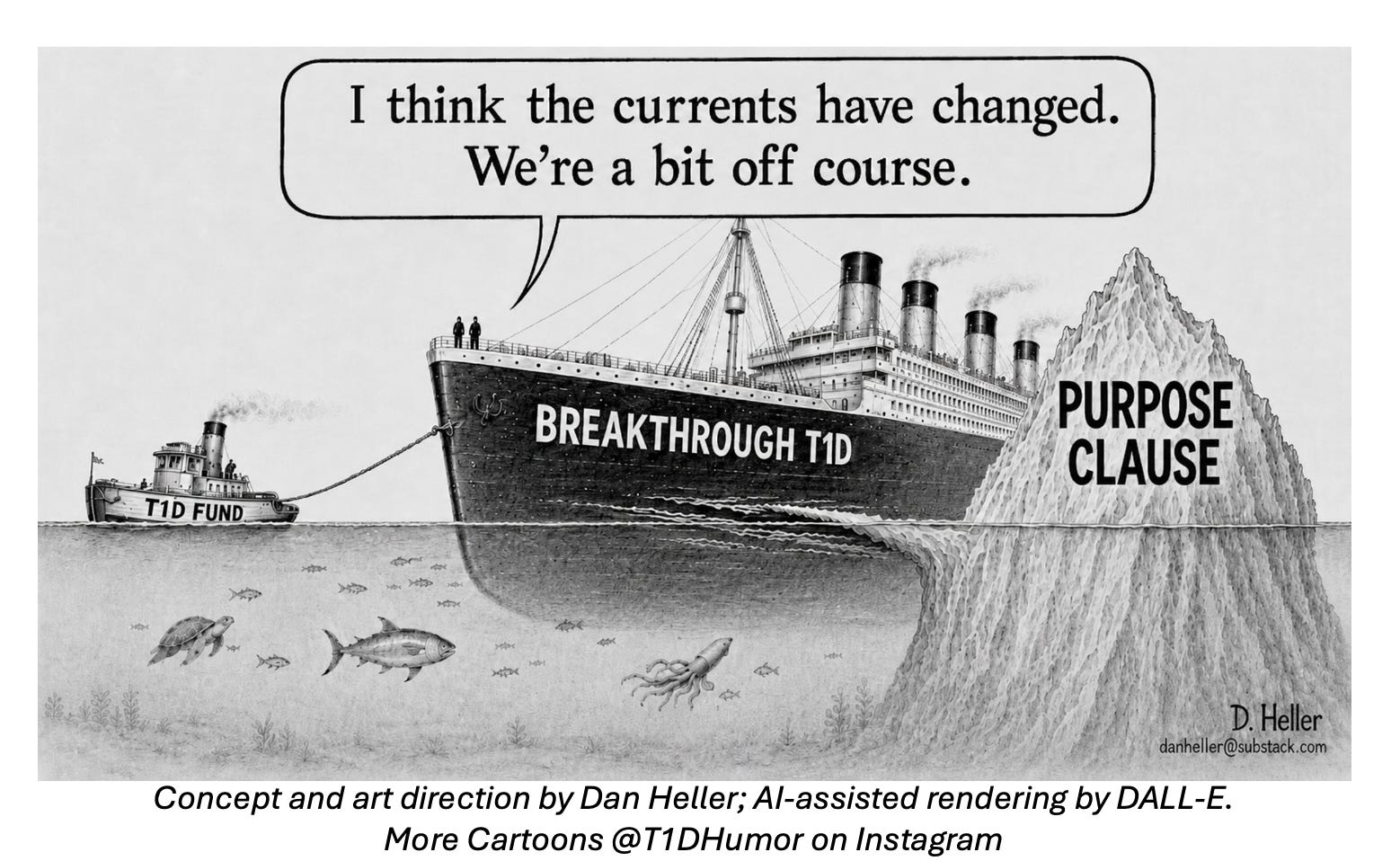
If you follow type 1 diabetes closely, you’ve probably heard that something sudden happened at BreakthroughT1D this summer. The T1D Fund, a subsidiary of BreakthroughT1D that invests in outside companies working toward a cure, had its board dismissed without notice. Governing documents were rewritten overnight. The largest donors in the field — families who have each given north of $100 million — found out after the fact, and at least one resigned in protest. There are open letters circulating, and a watchdog organization publishing on it, and a lot of speculation about who did what to whom.
To distill it as succinctly as possible, two things went wrong at once. The first is that the Fund drew enough internal concern that the above alterations were made (confirmed by the organization itself). And the second is that these actions caused major donors to walk.
We don’t know what those concerns were. What’s on the record is only what BT1D did about them. (BT1D is how BreakthroughT1D refers to itself. It should not be confused with BT1 — Beyond Type 1 — a separate organization with nothing to do with any of this.)
That said, the Fund itself, and the money it has access to, remains intact (at the time of this writing). As such, the story is not over.
As for the donors that walked, the most visible is David Panzirer, a main trustee of The Helmsley Charitable Trust, a now-former board member of the T1D Fund and one of its original founders.
On June 18, 2026, Panzirer resigned from The T1D Fund. In his open letter, which I have seen (though is not on a public website that I’ve been able to find), Panzirer stated: “What Breakthrough did by firing the Fund Board with zero notice or transparency has alienated the 4 largest families in T1D all within 48 hours. Each family has committed well over $100MM to the cause. NOTHING will happen if we don’t all stand up and demand transparency.”
An open letter that asks people to stand up and demand transparency invites outsiders like me to look at what’s available in the public record. The firings happened, the resignations happened, the documents were rewritten — but that narrative doesn’t tell you why any of it happened, or what comes next.
That’s the hull breach. If it isn’t repaired, the shakeup, and the alienation of key donors, stands to take the whole organization down. Without major funders, BT1D can’t survive. And those donors set the barometer for others that follow. The whole ship could sink. On the other hand, the reason the organization had to take action must have been important enough to take that risk.
My aim here is to focus on the Fund’s investments because that was its only function: investing to accelerate the cure. Whatever the problem was with the Fund, or between the Fund and BT1D, it starts there — and where that takes us is the journey towards resolution.
What the T1D Fund is
Structurally, the T1D Fund is a separate, wholly owned subsidiary of BT1D. Launched in 2016, it’s an LLC with BT1D as the sole member. The Fund files no return of its own, so its investments sit on BT1D’s balance sheet. Its managing directors are BT1D employees.
Its purpose is that of venture philanthropy, a means by which a charity can make investments in companies that serve the mission and turn a profit that can then be used for more investments. The model was originally conceived in 1969 by John D. Rockefeller III, one of the largest philanthropists of his generation. It has been adopted by many charities, ranging from school programs to other medical conditions. It is an excellent way for charities to fund startup companies that develop technologies in keeping with their mission.
However, it’s not universally a good fit, particularly for type 1 diabetes.
To be sure, that was not always the case. When the Fund was originally formed, it invested in companies that were strictly focused on T1D, and not only did those companies succeed, but the Fund returned over $100M back into its coffers, ready to be invested again.
But the technological landscape changed. The companies making the technologies that lead to a cure are not focused on T1D anymore — they fall into general categories, like immune tolerance and stem-cell derived tissues and manufacturing. All of these are essential for a cure, but none of them are focused on T1D. While investing in T1D-specific companies did engage them to focus on the disease, that investment is not effective with these generalized companies. They have other, more lucrative targets in mind.
Making matters worse, because the companies are not focused on T1D, it can be argued that the Fund is not permitted to invest in them. This kind of investment vehicle (the Fund) requires companies to be directly “on mission”, or the tax-exempt status is compromised.
Since the real goal is to get these companies to actually do T1D-specific activities, a more effective model than investments is contracts. That is, just pay the companies to do the work you want done. Same money, different incentive structure. All of it on-charter.
But of course, you don’t want to just throw money around without a plan. There needs to be coherence—a strategy. This is where BT1D can act like a general contractor, by taking direct ownership of the whole pipeline and outsourcing each of the parts in a coherent roadmap towards a cure.
All this is what makes our particular disease unique from many others and why venture philanthropy doesn’t work here.
To be clear, two things can be true at once: no one at the Fund did anything wrong; it was a slow creep of technology drift that made “investments” less effective as a means to generate outcomes. At the same time, those investments may have been seen as a tax risk, due to their off-charter profiles. In short, the Fund may have just outlived its utility, and the money it holds may be better used elsewhere. That doesn’t attribute fault, though it could certainly explain disagreement. Perhaps vigorous disagreement.
Whatever prompted the concerns, we don’t know. But the way BT1D acted on those concerns may have made things worse, and it’s important to include this in the story because, without the investors that have walked, the ship may not actually reach its destination.
Finding a cure to the breach is essential. And to do that, we need to build upon what was just described above. Once we find a model that works, we can then use that as a blueprint for both the donors and the organization to consider.
The Hull Breach
For its first years, the Fund invested in entities squarely aligned with curing T1D, and the record shows it: Semma (islet replacement), Provention (teplizumab, which became the first FDA-approved drug to delay T1D onset), Pandion (immune modulation), and a row of T1D devices — Bigfoot, Biolinq, Capillary, Diasome, Protomer.
As the Fund’s page stated, it has “realized nearly $100 million in profits from portfolio returns” since inception, and that “every dollar has been reinvested to support future investments in promising T1D therapies and cures.”
As noted earlier, the currents changed. The technology worth investing and re-investing was no longer about T1D specifically. It broadened into immune tolerance, which isn’t just a T1D problem. So, the Fund’s investments went where the science went. Companies whose sole focus was T1D were becoming fewer and less relevant, and the money followed. Hence, the drift.
But one can say that these are essential to a cure, therefore, they’re related enough. Yes, but the distinction matters, and its subtlety may explain the murky waters of the disagreement.
A mechanism is how a drug works. An indication is what it’s approved to treat — the specific disease named on the FDA label, which a company only gets by running the trials to prove it. That technicality changes what the Fund can invest in, and also whether that investment actually motivates the company.
A company organized around mechanism says, “we suppress T cell activity, and we’d be delighted if type 1 diabetes turned out to be a beneficiary.”
A company organized around indication says, “we are proving this works in type 1 diabetes, and we’re spending the money to put it on the label.”
The Fund’s own portfolio page organizes its holdings into strategic areas, and the largest single bucket is “Immunotherapies” — a mechanism, not an indication. Three samples among the group:
COUR Pharmaceuticals — nanoparticle therapies delivering disease-specific antigen or allergen to antigen-presenting cells in the spleen and liver
Jaguar Gene Therapy — filed under Beta Cell Therapies, with no beta cell in the description
Eledon — clinical-stage transplantation company. No mention of diabetes at all.
Not one of those names an indication. And the Fund’s homepage puts a number on the whole operation: 25+ companies, over $250 million in assets under management, most of them are mechanisms, not indications.
Here’s the part that bites: Each company got money from the Fund, but is under no obligation to produce anything. In the original companies, that wasn’t a problem because T1D was the only purpose of the company. That’s the difference.
So, put it all together: the Fund was investing in companies it might not be allowed to invest in, and the companies were not obligated, let alone motivated, to advance towards a cure.
If the sole purpose of the Fund is to make investments, these two problems suggest the Fund may have outlived its utility.
Now, this doesn’t preclude BT1D from working with these companies. Indeed, this is what contracts do: they pay the company to perform a specific service. But that’s a separate pot of money. In short, BT1D would have spent less and gotten the same work if they didn’t invest in equity, but instead just engaged in contracts. And the money they didn’t spend on an investment could have paid for another contract, such as a clinical trial.
If it was deemed that the Fund was not only unnecessary and a potential tax liability, it only amplifies the problem because there’s $250M allocated to it, either invested in companies doing nothing, or is waiting to be invested that do nothing.
Consider Eledon. The company has stated formally that it has no interest in T1D at all. They’re interested in whole organ transplants — kidney, liver, pig organs and the like — with the primary aim of supplanting tacrolimus as the immunosuppressant drug, which currently commands a $7B annual revenue stream.
BT1D owns stock in Eledon. BT1D also funded a clinical trial that happens to use Eledon’s drug, tegoprubart: an investigator-initiated islet transplant trial at the University of Chicago. Those are two separate pots of money doing two entirely different things.
The trial money bought an activity — T1D patients receiving islet transplants under a specific protocol, with measurable outcomes. That’s exactly what a charity should be paying for.
The stock bought nothing. It didn’t cause the trial. It doesn’t obligate Eledon to run another one, or to pursue an FDA indication in T1D, or to keep the drug available if the program gets deprioritized. Eledon owns the molecule, owns the regulatory path, and owns whatever comes next. BT1D owns some shares. They have zero control.
Run that across the portfolio and the pattern holds. Investments don’t compel companies to do mission-related activities. Only directly funding the specific activity does that.
As for my references to whether the investments were permissible, this is where BT1D’s “purpose clause” comes in. It’s stated in its articles of incorporation, and corroborated in its IRS Form 990: “improving lives today and tomorrow by accelerating life-changing breakthroughs to cure, prevent and treat T1D and its complications.”
Every word of that is bounded by a single disease. Not autoimmunity in general, not immune tolerance as a science, not cell therapy as a platform — type 1 diabetes. Investments made by a charity are supposed to serve that purpose.
The defense would be that the companies are “mission-related” — that a tolerance platform which could someday serve T1D is close enough. And that argument isn’t frivolous. But look at how it works in the Eledon case. BT1D paid for the trial that created Eledon’s T1D association, and that association is what makes the investment look mission-related. The nexus was manufactured by the investor.
No tax authority has ruled on any of it, and we don’t know if this may or may not have come up at a board meeting. That aspect notwithstanding, the greater point is that investing is not strategic. Even if every position were bulletproof on charter, the money still wouldn’t be buying activity. The tax concern may have been real, but it’s also beside the point to the larger picture.
Cue the iceberg.
$250 million, sitting in companies BT1D doesn’t control, doing work BT1D can’t direct. Major donors have either left or threatened to leave. Metaphorically, the ship was taking on water. Not from a single catastrophic breach, but from a long scrape that took years to develop, and that nobody could see from the deck. Until someone looked.
It’s time to patch the $250M scrape in the hull.
BT1D Needs to Behave Like a Product Company
We’ve established that the cure will come from larger companies’ technologies, and we can write contracts with those companies to do activities. Some manufacture cells, others develop immune protection, others focus on the delivery method. But no one owns the assembled protocol, and none of them has any reason to build it — the eligible population is too small to justify the work.
That’s the vacancy BT1D should fill. It has the money, the convening power, and the patient constituency. It’s the only entity on the field that could own the integration. It needs to act like a general contractor.
And here’s a critical aspect to that: a general contractor works in the interests of the people it’s building for. It also has to be indifferent among its suppliers at the start — otherwise it isn’t running a procurement, it’s ratifying a choice already made by someone else. That’s where owning stock in the suppliers becomes a problem. Not because anyone is acting improperly, but because it removes the one party whose job is to ask whether a different supplier would do better.
The thing about contracts is more than just funding the activity, it also sets terms, and those terms need to be sure of the optics of conflicts of interest. This is not easy, but it’s doable with the proper disclosures and more critically, internal due diligence of BT1D advisors and board members who themselves should be bound by conflicts of interests and firewalls between divisions. (I address this concern about BT1D in my article, Standard of Care: Who Defines it, How, and Why it Matters.)
For example, Eledon’s tegoprubart isn’t alone in its drug class. The following are in the same class.
dazodalibep — Amgen (developed at Viela Bio, acquired by Horizon Therapeutics, then Amgen). Two Phase 3 studies in Sjögren’s disease, completion expected H2 2026.
TNX-1500 — Tonix Pharmaceuticals (Nasdaq: TNXP). In April 2025 Tonix partnered with Makana Therapeutics on xenotransplantation.
frexalimab — Sanofi. Sanofi has projected peak sales above €5B/year based on Phase 2 MS data.
dapirolizumab pegol — UCB and Biogen, co-developed, in systemic lupus.
So with four other molecules in the same class, why tegoprubart? Possibly because it’s the best one — it has properties that reduce the clotting risk that plagued earlier CD40L drugs, and that’s a real differentiator. Though the competitors are possibly working on that. Probably.
But there’s a lot of “possibly” there. Why not the others as well? Were they thoroughly investigated? Did anyone engage in negotiation? Who ultimately made the decision?
No one from BT1D did; it was Dr. Piotr Witkowski, head of the UChicago program. He chose it. Why? We’d like to think it was the best choice. And maybe so.
But, there’s optics: In a January 2025 Frontiers in Transplantation article he discloses consulting relationships with Sernova, Eledon, Vertex, and Seraxis, a seat on a Vertex trial steering committee, and equity interests in Eledon and Sana Biotechnology.
None of the four alternative-molecule companies appears on that list. No Amgen, no Tonix, no Sanofi, no UCB or Biogen. Of the five molecules in the class, Witkowski holds a disclosed equity position in exactly one — the one under test.
Oh, and so does BT1D.
Maybe the other four are genuinely inferior for this application. Maybe they were never available — big pharma has little reason to supply a drug to a small islet trial. Both are plausible, and neither has been written down anywhere.
That’s the gap. There shouldn’t be maybe’s and probably’s. A general contractor would want its non-conflicted scientific committee to produce a report saying not just why tego is preferred, but why the alternatives were ruled out. Nobody in this chain had a reason to ask that question — which is different from saying anyone avoided it.
To reiterate: nothing’s inherently wrong or improper about these relationships. Financial entanglements are unavoidable in a field this small. But BT1D could be more self-aware of the optics when independent observers see the connections. Scientific researchers that sit on BT1D committees can be thorough in their assessments about what to fund and publish a competitive analysis when making those recommendations. And they themselves disclose their conflicts.
Not owning stock may improve the optics of course, but it also makes the optics of drug recommendations not only more transparent, but scientifically more rigorous.
As it happens, it’s what the old JDRF used to do. The Industry Discovery & Development Partnerships (IDDP) program made funding available to for-profit companies worldwide, publicly or privately held, focused on a priority area within JDRF’s mission, structured to take promising T1D research through discovery and development toward commercialization. This is what funded the advancement of automated pumps and other technologies used in daily management. And independent analysts were there the whole time.
These contracts also came with terms. In 2013, JDRF committed up to $3 million to Tandem Diabetes for a dual-chamber infusion pump, paid against development milestones. The program was terminated in 2016 after $0.7 million had been disbursed — and under the contract, Tandem repaid all of it. The money came back. That’s what a term does that a share of stock cannot.
There are two more advantages to a contract that BT1D has never leveraged. The first is a royalty back to BT1D on any product that comes out of work it funded. The second is a say in what that product costs the patient. Neither is available through an equity investment at any price. And crucially, can be set up to avoid the conflict-of-interest problem.
Royalties and Affordability
Funding trials is important. The problem is funding them as grants with no strings attached, while separately buying stock at the same time. This strategy yields no leverage of any kind — the kind that will actually matter later, especially if the trial succeeds and there’s a genuine pathway to a cure.
A better approach is to use the same money that went to both the trial and the investment, and bundle it all into a contract that has terms. Two of them, and the first is simple: BT1D funds the trials, builds the regulatory pathway, and delivers an FDA-approved T1D indication the company was never going to pursue on its own — in exchange for a royalty on commercial sales.
Yes, royalties. Again, standard practice for a set of conditions like this.
The company gets a free label expansion and some revenue for work they get paid to do that requires no effort on their part. Once the product hits the market through an FDA-approved protocol, the company receives revenue, and BT1D takes a cut of it in the form of royalties.
Which brings us to the second term, and it’s the one nobody thinks to write. Royalties can be lucrative for everyone, but they’re a double-edged sword for a patient organization. Making money is fine. Making it on your own constituents’ backs is not. So when the protocol is eventually approved by the FDA, what will the price be to the patient?
A curative therapy for a small population is exactly the kind of drug that ends up costing millions to develop — the orphan-drug trap, where a tiny patient pool has to carry all of it. For BT1D, that would be a disaster. The last thing BT1D wants to announce is that the protocol for islet transplants is FDA-approved, but it’ll cost $500,000 per patient. They want that price to be low, even though it would cut into their own royalty stream.
The canonical case is the Cystic Fibrosis Foundation’s relationship with Vertex Pharmaceuticals. Beginning in the late 1990s, the Foundation committed roughly $150 million to Vertex’s modulator program — work the venture market then considered too early and too risky — in return for royalty rights on anything that resulted.
Yes, they negotiated royalties, but that’s it. They didn’t anticipate what it would cost patients. Vertex charged patients $300,000 a year. And the royalty did something worse than fail to protect patients. It put the foundation on the wrong side of the price. Every dollar Vertex charged flowed partly back to CFF, which meant the organization that existed to serve CF patients had a financial interest in the number that kept some of them out.
That’s the mistake BT1D does not want to repeat. It’s here where BT1D would want to get its own price for the drug, separate from list price, so that when the protocol becomes available in an FDA-approved therapy, the company doesn’t charge prohibitively expensive amounts. The fix isn’t a list-price discount—it’s an indication-specific net price capped via foundation-administered rebates, regardless of the sticker price. The patient pays $10,000 instead of $500,000, not because the drug is cheaper, but because BT1D bought that difference when it was the only buyer in the room.
The next question is how to unload the water in the ship and keep it from sinking. What will BT1D do with all the equity that it owns?
Unwinding Existing Assets
As noted earlier, there is a very large amount of money sitting still, some of it locked up in stock that isn’t producing any work, and the rest is cash, designated for buying more stock that also wouldn’t produce any work. None of it is paying anyone to do anything. And every dollar of it could be funding a component on the roadmap starting tomorrow.
An obvious objection: isn’t this money restricted? Donors gave to the Fund, so doesn’t redirecting it require their consent? Mostly, no. The FY25 audit puts donor-restricted net assets for the T1D Fund at $3.2 million — about 1.6% of the total. The rest is board-designated, which means the board that designated it can un-designate it.
So the question isn’t how to clean up a compliance problem. It’s how to get the money moving.
The Fund’s own page claims over $250 million under management. The audited number tells you where it actually is: $65.5M in programmatic investments plus $5.8M in programmatic notes — $71.3M at fair value, spread across roughly thirty companies. The rest is either already exited or hasn’t been deployed at all, which turns out to matter enormously.
The composition determines the options. Of the $65.5M, only $8.8M is Level 1 — publicly traded, sellable Monday morning. The other $56.7M is Level 3 preferred stock in private companies, which is exactly as stuck as it sounds. So the clean exit covers about twelve percent of the portfolio, and the hard problem is the remaining $62M.
But the largest number in this story isn’t a position at all. The same audit shows $124.1M of BT1D’s operating investments designated as Fund-related and unavailable for general expenditure — undeployed capital, reserved for equity investing, never put into anything. There’s no counterparty, no secondary market, no discount, no negotiation.
Sit with that one. It’s not stuck in a company. It’s not illiquid. It’s not waiting on anyone’s signature but BT1D’s own board, which designated it and can un-designate it. It is nearly twice the size of the entire deployed portfolio, and it has been sitting there — earmarked to buy stock that produces no activity — while other components of a cure go unfunded.
That reframes the exercise. The hard part is $62M of illiquid preferred. Everything else is a vote.
For the assets in the portfolio, holding the positions and documenting a T1D rationale for each amounts to hoping the aggregate can be argued into the charter. Where mission-relatedness can be confidently argued, that’s another matter — and those positions should be identified. For the rest, two options.
Option 1 — Convert equity to contract. Go back to each privately held portfolio company and renegotiate the equity into a fee-for-service or milestone structure tied to a T1D program. BT1D surrenders the shares; the company commits to the work. This is mutually beneficial, because BT1D gets a contract that assures the work, and for the company, cancelling BT1D’s position is reverse-dilution — everyone else’s stake goes up without anyone writing a check.
Which makes this the most useful option, because it’s also a test. A company already running a T1D program signs, because it’s committing to what it’s already doing. A company that won’t sign is telling you there was no T1D program to commit to. Either the conversion works and the money starts buying activity, or the refusal tells you the position was never doing anything.
And for companies that refuse, you move to Option 2.
Option 2 — Sell the positions. Clean, and the only option that converts dead capital into spendable money. Divest and redeploy the proceeds inside the charter via the contract model.
Publicly traded companies are easiest. Eledon, for example, is publicly traded, and those shares can just be sold. It doesn’t have any effect on the company’s balance sheet (it’s not buying equity back), nor does it have to affect the relationship it has with BT1D. In fact, BT1D can use those very proceeds to engage in the T1D-specific activities that they arguably should have done in the first place.
For privately held companies, this isn’t as clean, because private positions are illiquid — you’d have to sell into a secondary market that knows you’re a forced seller, at a discount. And the markdown would land on positions already being written down. Selling into that means realizing a loss on top of a loss.
But there’s a negative side to the company for the same reason. That new highly-discounted trade sets a reference price that follows the company into its next round. If a company was worth $10M, but BT1D’s sale values it at $2M because they had no choice but to liquidate, that downgrade hits all shareholders the same, and makes it hard to raise money at even the previous valuation. If that’s not bad enough, the company may also have an unfriendly shareholder on the books, which could be devastating.
So for private companies, both BT1D and the company have a strong interest in option 1.
None of this is exotic. These are standard instruments, and the lawyers on both sides have done conversions like this before. What’s needed is the decision, not the invention.
What about the donors? What about the families?
Right now, nothing is happening. The Fund remains intact, and no money has moved. The governance fight is not worth arguing about. So, what’s next?
BT1D lost its largest funders, and that can have a devastating effect, not just financially, but on its own good will. It’d be like a startup company’s largest investor selling its own position for pennies on the dollar. No one wants to touch it.
And the families and other donors are distancing themselves from the one and only vehicle (BT1D) that has the infrastructure, scientific and political connections, and academic resources that can move the right technologies towards a cure. Sure, they could try to rebuild a new institution, but that’s a lot of money, time and work that could just as well be implemented in BT1D given the right planning and incentive structure.
The right path forward between them is not dissimilar from what we’ve learned about equity investing: you don’t just give someone money and hope. You write contracts with terms — money attached to specified work, with obligations, milestones, and consequences for non-delivery.
The donors should do exactly that, one level up. Not a demand for transparency, which is a request. Not a threat to withhold, which burns the thing everyone claims to want. A gift agreement with terms: fund the roadmap, name the deliverables, require the reporting, require conflict of interest boundaries (not just in funding grants and contracts, but throughout the whole organization), and specify what happens if the work doesn’t get done.
At its core, this is actually a collaborative, outcome-focused act. It’s the same discipline BT1D should be applying to its own suppliers as well. If the model is right for one, it’s right for both. If BT1D can’t be held to deliverables, then it has told you something about whether it intended to deliver.
Nobody has to lose for this to work. BT1D gets a better instrument, and a plan it can show donors. The donors get accountability without a courtroom. The companies get funded work on an indication they’d abandoned. And the patients get someone finally building the thing instead of buying pieces of the people who might.
I think that more investigation is needed into what exactly is happening at Breakthrough T1D and the T1D fund. Breakthrough T1D received 277M in donations last year alone. T1D fund has 250M under management total over the life of the fund. The real issue is how breakthrough T1D is spending these funds and getting very little to show for it over the years. They are paying executives 7.5 Million per year though so there is no rush.